
Latest Editions
-
 Quest Issue 2, 2022
 -
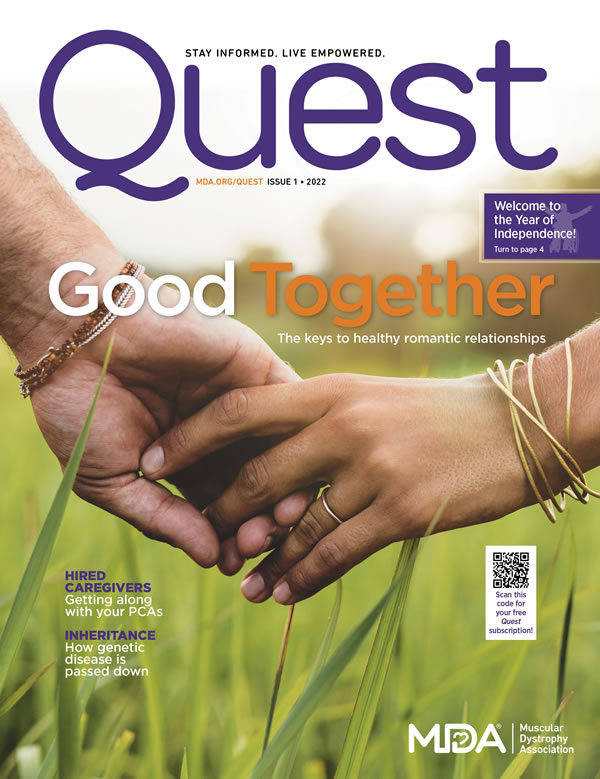 Quest Issue 1, 2022
 -
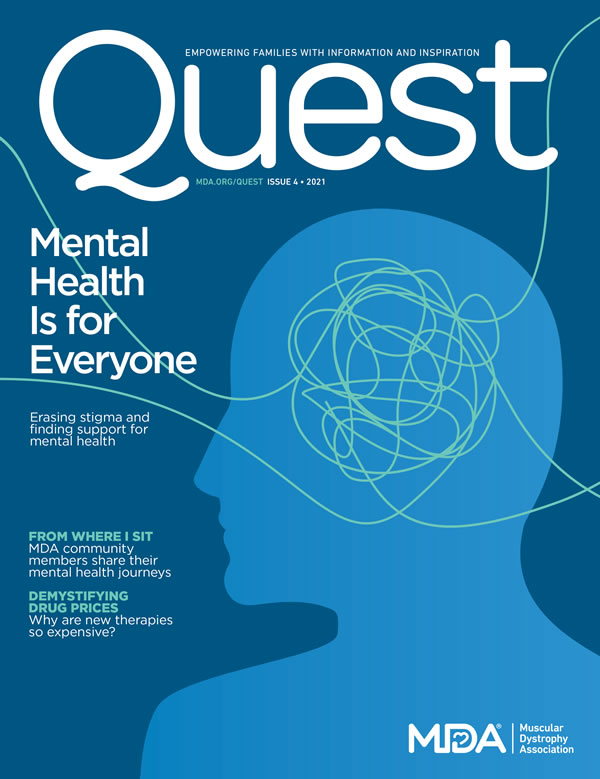 Quest Issue 4, 2021
 -
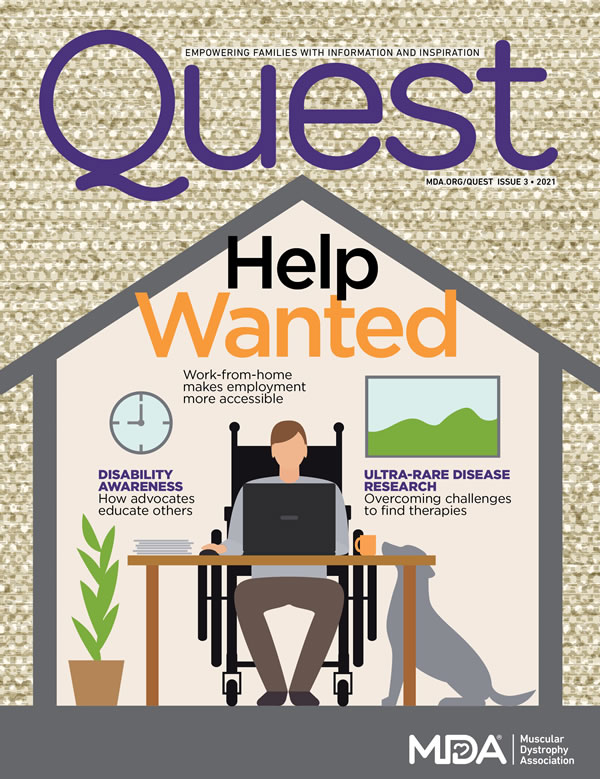 Quest Issue 3, 2021
Recent Quest Articles

Strike a Pose
Editor’s Note: Always consult with your MDA physician and MDA Care Center team before beginning any kind of exercise program. Twenty-eight-year-old Chelsea Singer is not the typical yoga instructor. Her feet are deformed as a result of contractures and stiffened joints. Her hands shake, her knees frequently dislocate, and she lacks sensation in her extremities. Diagnosed with Charcot-Marie-Tooth disease (CMT) at age 11, Singer grew up believing she was frail and found physical activity, such as hiking, painful.
Read More
Home Smart Home
As the world awaits the full realization of the Internet of Things (IoT) — the computer- based platform on which all home automation will reside — the individual products and innovations that will one day comprise it are slowly trickling out. These smart home technologies will likely end up in all homes in the future; however, the difference in their effect on a typical homeowner compared to one living with muscular dystrophy, ALS or a related muscle- debilitating disease is the difference between additional convenience and a game-changing transformation.
Read More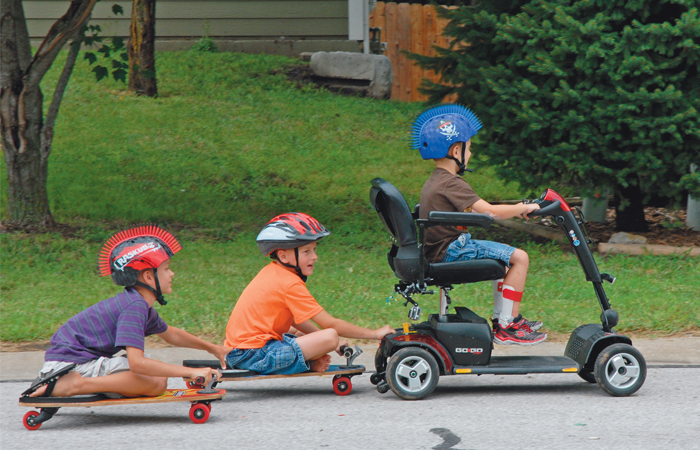
Access MDA Spring 2016
Dennis Bracety had been fighting fires in Tucson, Ariz., for almost 10 years when he first started to experience symptoms of what he would eventually find out was dermatomyositis, a neuromuscular disease that causes inflammation of the muscles and skin.“My symptoms started in November 2010 at our annual Turkey Bowl Thanksgiving event,” Bracety says. “I felt sluggish, and I didn’t feel alert. Something was off, and I knew it. For the next three weeks I ignored the symptoms; I’m a macho guy, I figured I would be fine. It wasn’t until Christmas Eve [that I recognized something was seriously wrong] when I was on duty, and I just couldn’t get out of bed.”
Read More
Keeping Families at the Center of Our Mission
One of the most enjoyable privileges of my role is visiting with MDA families we proudly represent and are committed to serving. You are at the heart of everything we do at MDA. You’ve heard us say that, but what does it mean to families like yours? Earlier this year, MDA launched a revitalized brand to better reflect the voices and needs of families and a bold plan to enhance the research, care and support we provide to you. This includes the experience and care you receive at MDA Care Centers (formerly called MDA Clinics) in hometowns across America.
Read More
The Heart of Our Mission
Joseph (Joe) Akmakjian, who was diagnosed with type 2 spinal muscular atrophy (SMA) when he was 15 months old, will turn 25 this year. In 2015, to celebrate his 24th birthday and doubling his life expectancy, he didn’t have the standard cake and ice cream with friends and family. Instead, he and 11 friends went skydiving to mark the occasion. Akmakjian was securely strapped to his skydiving instructor, wore a neck brace, and his arms were restrained across his chest. As he got ready to feel the wind on his face at 120 miles per hour, he shouted, “YOLO!” short for “You only live once.”
Read More
Progress Now Winter 2016
At MDA, we take a big picture perspective across the full spectrum of neuromuscular diseases to uncover scientific and medical breakthroughs that accelerate treatments and cures. The power in our research approach is that we can often apply learnings from one disease to progress in others to bring urgently needed answers to our families. Take a look at what's happening in research and clinical trials for Winter 2016.
Read More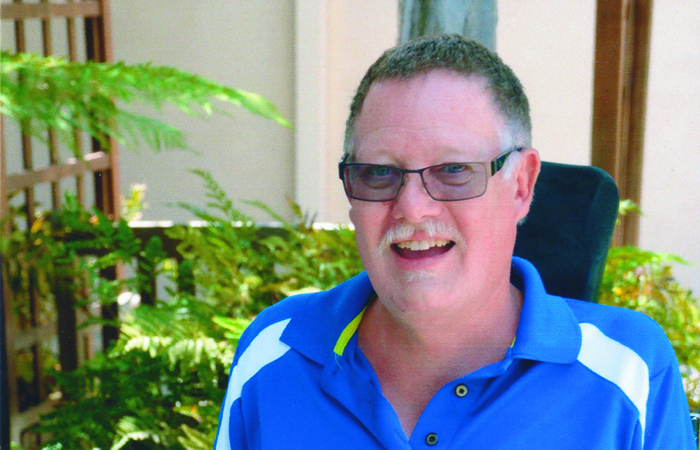
At Your Service
Eric Cook, who has limb-girdle muscular dystrophy (LGMD) and uses a power wheelchair, no longer struggles to pick up the TV remote or his glasses when he drops them on the floor. Instead, the 57-year-old retired engineer relies on his service dog, Dusty, to help him with these and other needs. In total, Dusty knows and responds to 40 different commands for everyday tasks like turning on a light switch, pushing an elevator button or opening the refrigerator door. When Cook begins to slump in his wheelchair, he even has a command for Dusty to gently nudge him back into an upright position.
Read More
Fashion Forward
Children and adults living with neuromuscular diseases often have to make a choice between fashion and function. Skinny jeans and tall lace-up boots may be all the rage, but items like those present plenty of challenges in terms of getting them on and then staying mobile afterward. Even regular jeans and sneakers can be a hassle, leaving many to simply don sweatpants and slip-on shoes, but self-esteem can take a hit as a result.
Read More
Making Life Work for You
Life isn’t easy whether you are living with a neuromuscular disease or not. I recently came to the realization that there are four main strategies for being happy in my life and that enable me to make sure my life is working for me and my family. While there is no one-size-fits-all formula for achieving a happy life, I hope my experiences and the tips below may help provide some insight into how you can have a life that works for you, especially if you’re feeling like you’re not quite there — yet.
Read More
Strength in Numbers: Focused on Families
Families are at the heart of MDA’s mission to help kids and adults live longer and grow stronger. Here is a snapshot of how MDA supported our families in hometowns across America during 2015. Cure 200 Number of current research projects funded by MDA 103 Number of research grants awarded in 2015, with a total commitment of more than $27.3 million
Read MoreMDA Resource Center: We’re Here For You
Our trained specialists are here to provide one-on-one support for every part of your journey. Send a message below or call us at 1-833-ASK-MDA1 (1-833-275-6321). If you live outside the U.S., we may be able to connect you to muscular dystrophy groups in your area, but MDA programs are only available in the U.S.