
Latest Editions
-
 Quest Issue 2, 2022
 -
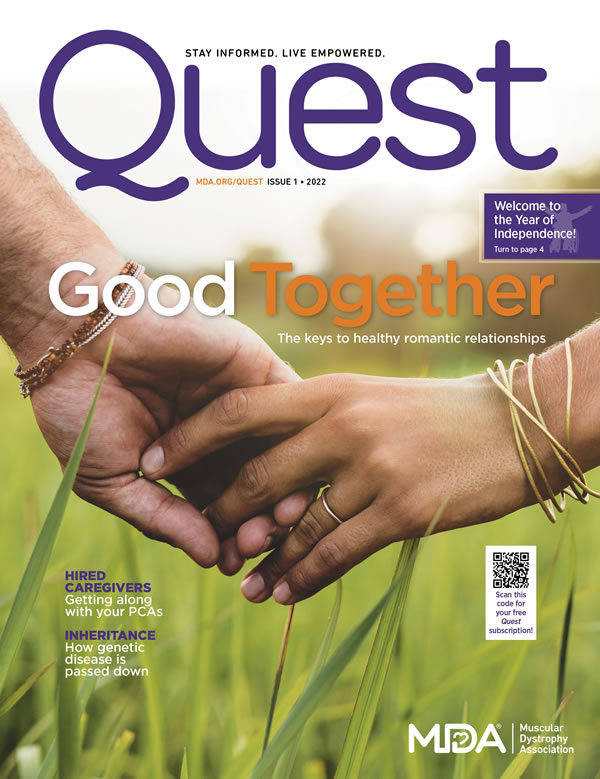 Quest Issue 1, 2022
 -
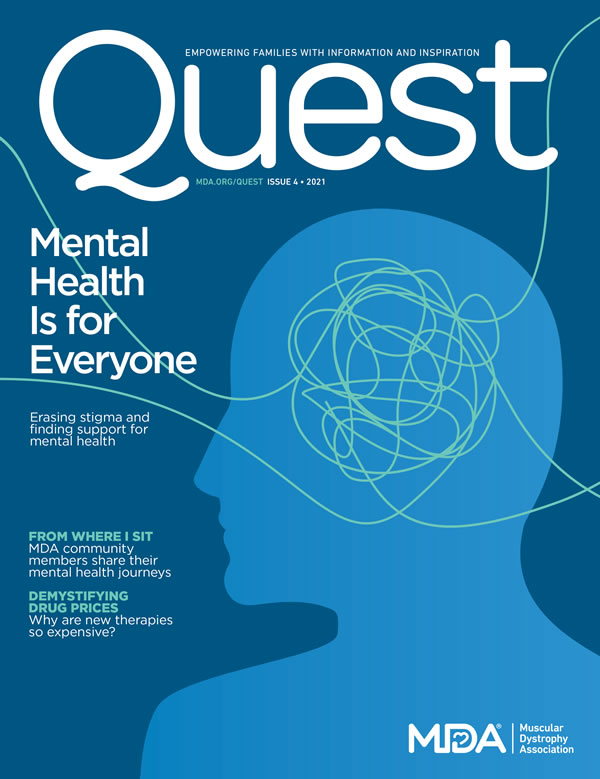 Quest Issue 4, 2021
 -
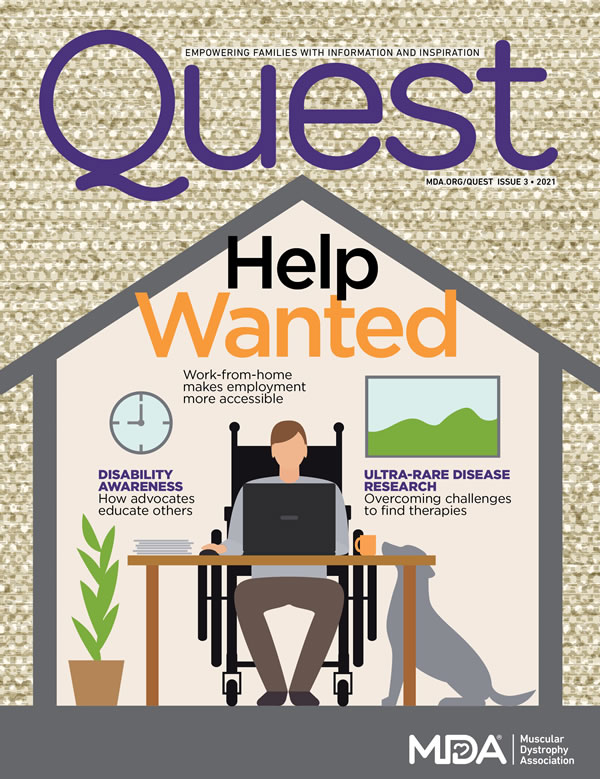 Quest Issue 3, 2021
Recent Quest Articles

MDA’s 2020 Clinical & Scientific Conference Trial News and Updates
When the novel coronavirus pandemic forced MDA to cancel our in-person 2020 Clinical & Scientific Conference, one of our first actions was to move the conference’s key Clinical Trial Session online. On March 24, every one of the more than a dozen speakers originally slated to present recent clinical trial results at the Orlando conference shared those results, instead, in a virtual meeting attended by more than 1,200 researchers and clinicians from across the nation.
Read More
Pompe Disease Treatment Is Moving Forward
Pompe disease (also called acid maltase deficiency) is a rare, inherited glycogen storage disease that affects the muscles, particularly the heart and skeletal muscles. It results from mutations in a gene that carries instructions to make the enzyme acid alpha-glucosidase (GAA), also called acid maltase, which plays a role in the body’s ability to process and break down complex sugars (glycogen). With insufficient GAA, glycogen builds up in and damages muscle cells.
Read More
Coping Through a Crisis
(Editor’s note: In the print edition of Quest Issue 1, 2020, Sarah Clark-Stoney, MSW, LSW, was misquoted. Her quotes have been clarified here, and updated in the full, downloadable PDF version of Issue 1, 2020.) Fifteen years ago, my family lived through Hurricane Katrina in Louisiana. At the time, our son was a freshman in high school. Falling pine trees and rain destroyed half of our home. Rebuilding took seven months, and we lived in the chaos during the process.
Read More
A Good Beginning: Newborn Screening
Early diagnosis and treatment for neuromuscular diseases that can be treated is crucial, as the disorders are progressive and, in many cases, fatal. Spinal muscular atrophy (SMA), for example, is the leading genetic cause of death in infants. While only a few years ago there were no disease-modifying therapies for SMA, today there are multiple lifesaving treatment options on the market.
Read More
The Importance of Genetic Testing
Kelly Berger, 31, of Cincinnati, spent most of her life chasing a diagnosis. When she was 3, her parents noticed that, although she reached physical milestones for her age, she did them in unusual ways. For example, to step up, she pushed off her thighs with her hands, and she preferred crawling on stairs to walking them. Her parents took her to a neurologist and, after bloodwork, an electromyography (EMG), and a muscle biopsy, she received a diagnosis of spinal muscular atrophy (SMA) type 3. That was in the early 1990s, when fewer types of neuromuscular disease were understood.
Read More
Living, Not Suffering
I often hear people say that I suffer from muscular dystrophy. I don’t like this use of the word “suffer.” I am living my life to the fullest, and don’t feel like I am suffering at all.I may need to ask for help sometimes or adapt to my surroundings, but I can always be myself. Coming to that realization took years of hard work and some tough life lessons.
Read More
2019 Lasting Impression Photo Contest Winners
Congratulations to Brent Gillespie of Benton, Ark., our photo contest winner.This photo, taken in the summer of 2019, captures Brent, 43, trying adaptive wakeboarding for the first time on Lake Ouachita, a popular spot for water sports in Arkansas. The men wakeboarding with him are volunteers from Wake the World, a nonprofit offering water sport experiences for people with disabilities, wounded veterans, and others.
Read More
Outside the Lab
Michael Lo Sapio, father of Mikey, 7, and Reid, 5, proudly admits that he’s pushy. Both his boys live with Duchenne muscular dystrophy (DMD), which causes progressive muscle degeneration and weakness beginning in early childhood. People with DMD typically live to their late teens or early 20s.These facts are grim, but being pushy means not accepting the statistics without a fight. For Michael — and many people living with neuromuscular diseases — one way to push back on the numbers is by participating in research.
Read More
Wheels Like Mine
I am a mom. I have spinal muscular atrophy (SMA). My son has SMA, too. Because SMA is a genetic disorder, these statements may not seem surprising. It wouldn’t be all that strange for a person with SMA to pass on their condition to their child. But that is not our story. Our journey to family is more convoluted and, dare I say, even more beautiful than most would guess. Ours is a story of love and adoption and beauty where others see tragedy.
Read More
What’s the Toy Story?
Barbies were a favorite toy of young Jessica Hetzel, despite the fact that the dolls looked nothing like her. It took until February 2019, when Jessica was 17, for Mattel to release a Barbie in a wheelchair. “I’m not playing with Barbies these days,” says Hetzel, who has spinal muscular atrophy (SMA). “But I was excited to see they finally did it.”
Read MoreMDA Resource Center: We’re Here For You
Our trained specialists are here to provide one-on-one support for every part of your journey. Send a message below or call us at 1-833-ASK-MDA1 (1-833-275-6321). If you live outside the U.S., we may be able to connect you to muscular dystrophy groups in your area, but MDA programs are only available in the U.S.