Facioscapulohumeral Muscular Dystrophy (FSHD)
Facioscapulohumeral Muscular Dystrophy (FSHD)
What is facioscapulohumeral muscular dystrophy?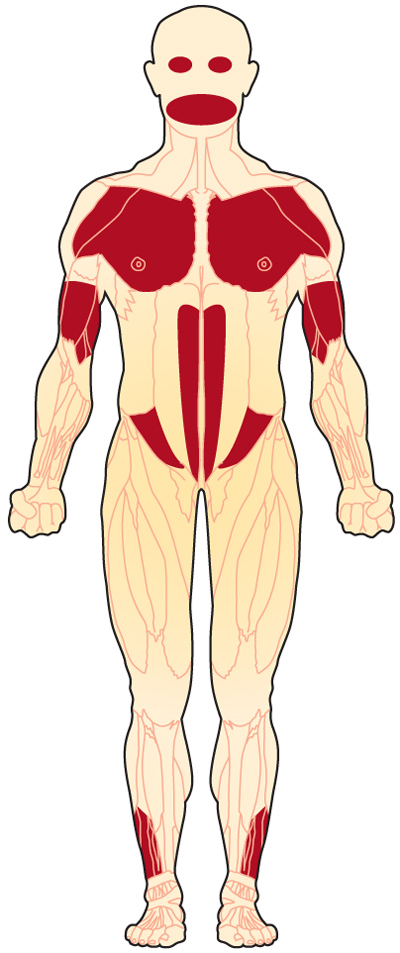
Facioscapulohumeral muscular dystrophy (FSHD) is a genetic muscle disorder characterized by slowly progressive, and often asymmetric, muscle weakness that most commonly affects the muscles of the face, shoulders, and upper arms.
The name reflects the areas of the body most impacted: “facio” refers to the face, “scapulo” to the shoulder blades, and “humeral” to the upper arms. As a form of muscular dystrophy, FSHD involves the gradual degeneration of muscle tissue, leading to increasing weakness and loss of muscle mass over time.
While symptoms typically begin in the facial and shoulder muscles, FSHD can also affect other muscle groups as the condition progresses. The severity and pattern of muscle involvement can vary widely from person to person.
FSHD is one of the most common forms of muscular dystrophy, with an estimated prevalence of about 1 case per 8,000 individuals.
What are the symptoms of FSHD?
FSHD causes slowly progressive muscle weakness, most commonly affecting the face, shoulders, and upper arms. Symptoms often begin in adolescence or early adulthood but can appear at any age.
Early signs may include difficulty smiling, closing the eyes tightly, or lifting the arms overhead. Weakness can spread to the abdomen and lower legs and is often asymmetric, affecting one side more than the other.
A rare early-onset form begins in childhood and may be more severe, sometimes involving hearing or vision problems. The severity and progression of FSHD vary widely.
For more, see Signs and Symptoms.
What causes FSHD?
FSHD may be inherited through either the father or the mother, or it may occur without a family history. It is caused by genetic changes that allow a gene called DUX4 to be turned on in muscle cells when it should normally be off.
In the most common form (FSHD1), this happens due to a shortening of a specific region (4q35) on chromosome 4. In a less common form (FSHD2), other genetic changes affect how this region is controlled. In both cases, the result is the same: DUX4 becomes active in muscle cells.
This abnormal gene activity is believed to damage muscle cells over time, leading to the muscle weakness seen in FSHD.
For more about the genetic causes of FSHD, see Causes/Inheritance. For more about how the missing chromosome 4 segment may cause FSHD, see Research.
What is the progression of FSHD?
FSHD usually progresses slowly, but the rate and severity can vary widely. It is generally not associated with heart involvement, and most people have a normal life expectancy. However, in some cases, particularly more severe forms, respiratory complications can occur and may be serious.
What is the status of research in FSHD?
Current research is focused on better understanding how the DUX4 gene is activated and how it causes muscle damage, as well as on developing therapies that can block or reduce its activity. For more, see Research.
Additional reading
- Preston MK, Wang LH. Facioscapulohumeral Muscular Dystrophy. 1999 Mar 8 [Updated 2025 Jul 10]. In: Adam MP et al., editors. GeneReviews® [Internet]. Seattle (WA): University of Washington, Seattle; 1993-2026. Available from: https://www.ncbi.nlm.nih.gov/books/NBK1443/
- Tawil R et al; Guideline Development, Dissemination, and Implementation Subcommittee of the American Academy of Neurology (AAN); Practice Issues Review Panel of the American Association of Neuromuscular & Electrodiagnostic Medicine (AANEM). Evidence-based guideline summary: Evaluation, diagnosis, and management of facioscapulohumeral muscular dystrophy: Report of the Guideline Development, Dissemination, and Implementation Subcommittee of the AAN and the Practice Issues Review Panel of the AANEM. Neurology. 2015 Jul 28;85(4):357-64. doi: 10.1212/WNL.0000000000001783.
Last reviewed April 2026.
Looking for more information, support or ways to get involved?
Find MDA
in your Community
-
Grants at a Glance
Read More -

Search for Clinical Trials
Learn More